
Archimedes Principle of Pulley


What is the Point of a Pulley?

In its simplest implementation, a pulley simply turns a force in one direction into a force in another direction. This might be useful if it’s easier to apply a force in one direction than the other (e.g. to pull downwards rather than push upwards).
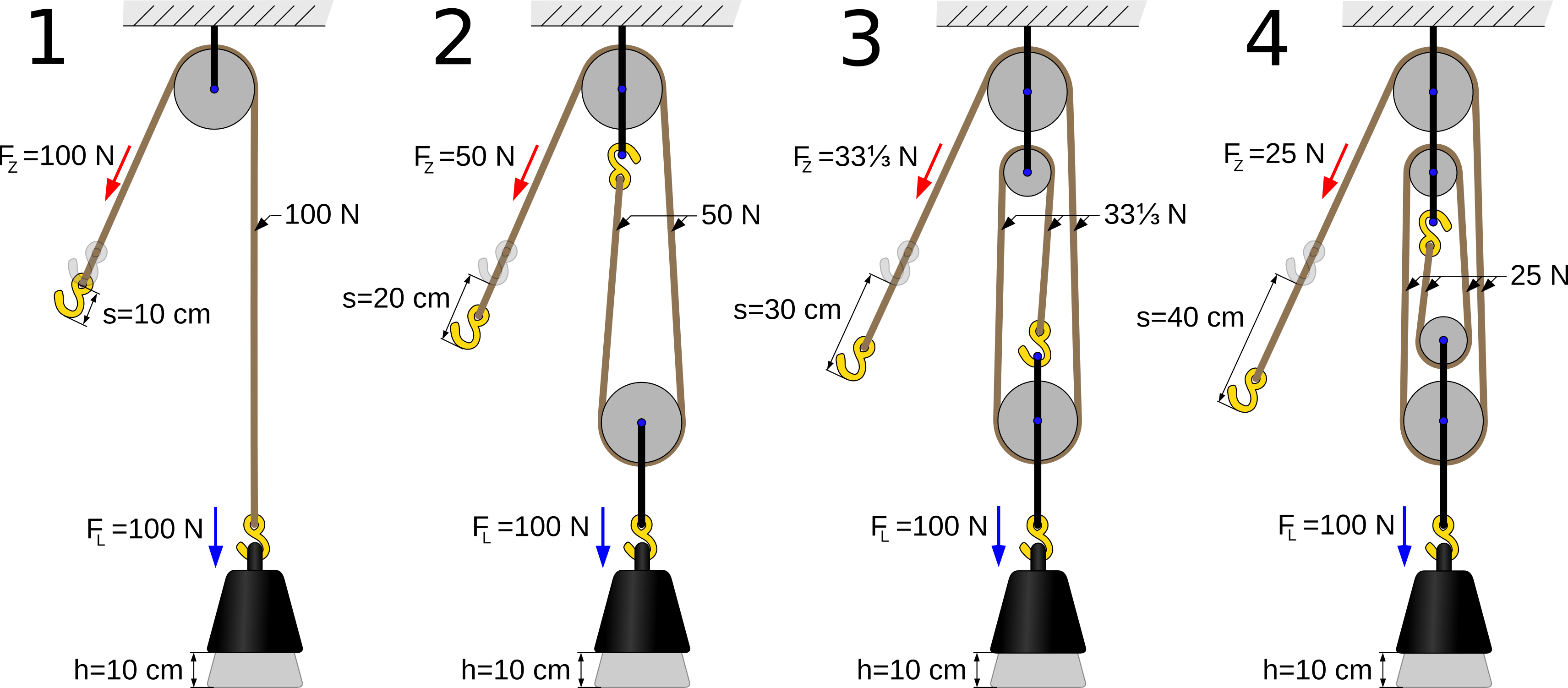
A pulley really comes into its own when it is combined with another pulley to create a system known as a block and tackle, allegedly invented by Archimedes in the third century BC.
The simplest block and tackle, the gun tackle, uses two pulleys, which are usually mounted above one another (for clarity, they are shown separated in the diagram below).

gun-tackle
The load (W) is shared between the tension in the rope and the mount that attaches the block and tackle to the ceiling, and thus you only have to pull with a force equal to half the weight in order to lift it. However, you will have to pull the rope twice as far and thus the conservation of energy is not violated (lifting a one hundred newton weight through one metre is the same amount of work as applying a fifty newton force over two metres).
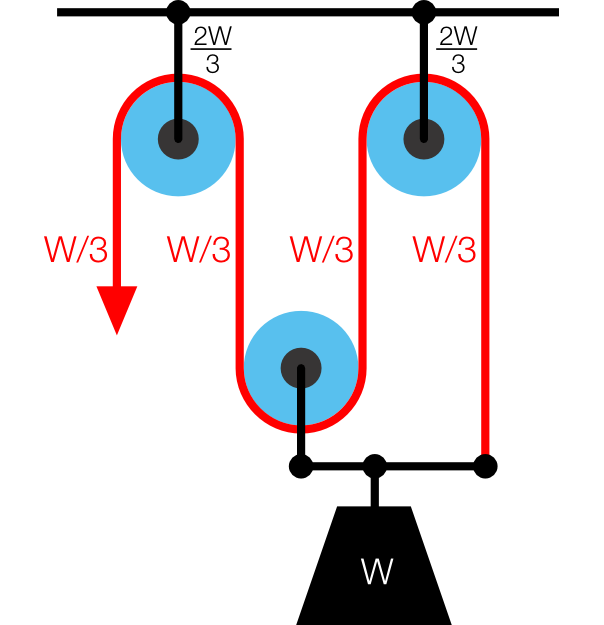
The Luff tackle uses three pulleys in theory, but this is usually accomplished by running a rope over the top pulley twice. In this case the force required to lift a weight is reduced to one-third of its actual value, but again you have to pull further: three times the height required in this case.luff-tackle
A Luff tackle, shown separated.
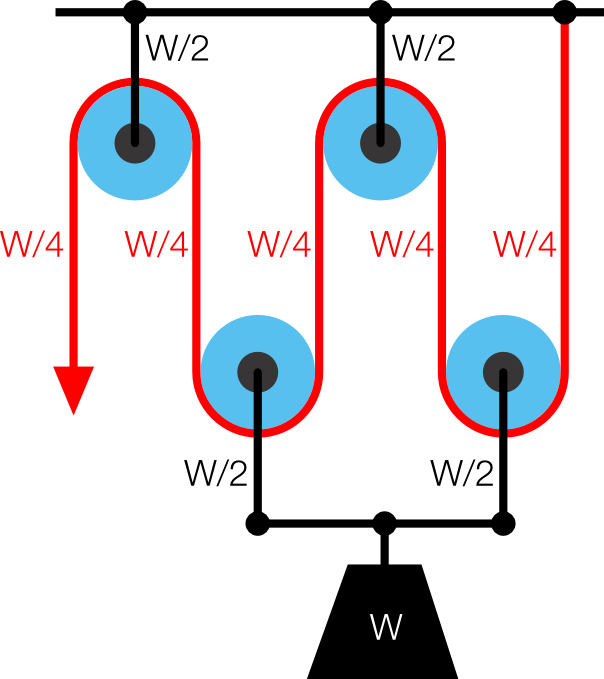
The double tackle uses four pulleys, but similar to the Luff tackle, this is usually accomplished by running the rope twice over both pulleys.
double-tackle
In theory, this process can be continued indefinitely (one is reminded of Archimedes’ alleged remark: “Give me a place to stand and I will move the Earth“) but it quickly becomes impractical to do so, as the length of rope required, and the distance pulled through become unmanageable.
block-tackle-eg

A block and tackle can also be created using pulleys of different sizes.

Comments

Popular posts from this blog

How To Remove Proxy Virus [127.0.0.1:8080] 100%[works]

Hi Guys! If you are seeing this blog means you have probably been disgusted by the proxy virus  127.0.0.1:8080  . That is When you try to connect to the internet it shows a  proxy server error or Can't connect to the proxy ,  Even when you try to change the proxy value you can't. It's not your fault, but of a certain Application or Browser that allows third-party apps to change the value and do anything (that a non-administrator user can do) . Actually, It Is a hacking virus that third-party app feed into your PC, or simply if you download any file from the Internet it gets attached too. Many Antiviruses Applications are unaware of this virus and don't block it, this is the case when our computer's antivirus won't work. It recognizes this virus as a file. This is a new type of virus that a hacker develops for gaining money cause it's their way to do it and they find it easy to use. In Youtube, there are such videos which show you how to remove...

Determination of pH [ Theory and Procedure ]

Our Objective Our objective is to determine the pH of the given sample using; pH paper  Universal indicator The Theory There are millions of chemical substances in the world, some are acids, others are bases and some are neutral.   Acids and Bases Acids are  substances that produce free hydrogen ions (H +  ions) when dissolved in water.   Bases are substances that produce hydroxyl ions (OH -  ions) when dissolved in water. Acidic solutions are rich in hydrogen ions and basic solutions are poor in hydrogen ions. Some acids dissociate only partly, releasing very small amounts of H +  ions, and are called weak acids. Others dissociate completely, releasing large amounts of H +  ions, and are called strong acids. In the same way, bases that dissociate partly are called weak bases and those that dissociate completely are called strong bases. pH of a Solution The acidic or basic property of substances is measured in terms of pH. It...